

The fastest way to run your email stack from an AI assistant is an email MCP server: a connector that lets Claude, ChatGPT, or Cursor call your email tools directly, in plain language. But "what is the best email MCP server?" is the wrong question until you ask "best for what." Sending, list cleaning, inbox triage, and deliverability testing are four different jobs, and the right server depends on which one you are automating.
This guide breaks down what an email MCP server is, how these servers actually work across platforms, a compared list of the best email MCP servers in 2026, and the strongest pick for the job email marketers neglect most: actually landing in the inbox.
What is an email MCP server, and why does it matter for email marketing?
The Model Context Protocol is an open standard, introduced by Anthropic in late 2024, that lets an AI assistant securely call external tools and data through one connection. An email MCP server is simply an MCP server that exposes email capabilities, so any MCP-aware client can use them: Claude Desktop, Cursor, or ChatGPT in developer mode, among others.
For email marketing, that collapses a tab-switching workflow into a conversation. Today you bounce between an ESP, a verification tool, a spam tester, and a dashboard, copying numbers by hand. With an email MCP server connected, you ask your assistant, "run a spam check on this campaign and tell me the score," and it makes the calls, waits for the result, and reports back in the chat. The same assistant that already drafts your copy can now test and ship it.
This is the natural next step after using AI for email marketing content. Prompts write the email; an MCP server lets the assistant act on it.
How email MCP servers work across platforms
Before comparing providers, it helps to know that almost every email MCP server follows one of two deployment patterns. Which one a vendor chose tells you how you will install it, how it authenticates, and how much you should trust it with.
Remote servers (hosted, OAuth)
A remote server runs on the vendor's infrastructure at a single HTTPS /mcp endpoint over Streamable HTTP. You authenticate by signing into your account in the browser and approving scopes, with no API key to copy and no package to install. This is the pattern for Klaviyo's recommended mode, Omnisend, ActiveCampaign, Kit, Customer.io, and Bird's hosted mode. Remote OAuth servers commonly default to read-only, with writes, sends, and sensitive-data access requiring explicit approval.
Local servers (self-run, API key)
A local server runs on your own machine over stdio, launched on demand with npx or uvx, and authenticates with a static API key passed as an environment variable. Resend, Mailgun, and Iterable use this model. The key never leaves your environment, but you manage it yourself.
Tool catalogs differ by philosophy. Marketing platforms tend to ship large, explicitly named catalogs, Kit exposes around 65 tools and Iterable 108, while some vendors deliberately expose a small set of generic primitives (read, write, search, execute) and let the model compose them. Across all of them, what the assistant can do is gated by the scopes you granted or the API key's permissions.
The four types of email MCP server
Most "email MCP server" results fall into four categories. Each solves a different problem, and a serious marketing stack often uses more than one.
| Email MCP server type | What it does | Best for |
|---|---|---|
| Sending / ESP | Draft and dispatch campaigns through an MCP email sending API | Composing and sending |
| Mailbox / inbox | Read, search, and triage incoming mail (IMAP, Gmail, Outlook) | Inbox management and support |
| Verification | Validate addresses and clean lists | List hygiene |
| Deliverability testing | Spam score, inbox placement, screenshots, heatmaps | Landing in the inbox |
Sending servers get the attention because dispatch feels like the whole job. It is not. You can build a flawless campaign and send it through a perfect MCP email sending API, and still have it filtered before a single subscriber sees it. In our own inbox-placement benchmark, mail from .com sending domains reaches the inbox only about 53% of the time; the rest is filtered to spam or dropped. Authentication gaps, spammy wording, and a worn sender reputation all sink delivery, and a sending server has no idea any of that happened.
The best email MCP servers for email marketing
Here are the email MCP servers worth knowing in 2026, grouped by the job they do. All of the servers below are first-party and officially supported unless noted.
Email marketing platform (ESP) MCP servers
These connect a full marketing platform, campaigns, automations, contacts, and reporting, to your assistant. They are the richest option if you already live in one of these tools.
| Platform | Hosting | Auth | Best for |
|---|---|---|---|
| Klaviyo | Remote or local | OAuth or API key | Ecommerce and lifecycle marketers; ~45+ tools for campaigns, flows, segments, reporting |
| Brevo | Remote | API key (Bearer) | Multichannel email + SMS + WhatsApp, with CRM; ~27 scopable modules |
| Kit (formerly ConvertKit) | Remote | OAuth | Creators and newsletters; ~65+ tools across subscribers, sequences, broadcasts |
| ActiveCampaign | Remote | OAuth | Automation plus CRM; 46 write-capable tools |
| Iterable | Local (npm) | API key | Enterprise cross-channel; 108 tools, read-only by default (beta) |
| Customer.io | Remote (US/EU) | OAuth | Behavioral messaging; small set of safe scoped primitives |
| Omnisend | Remote | OAuth | Ecommerce email/SMS/push with revenue analytics |
A few standouts: Klaviyo's server is the most complete for ecommerce, letting you ask "which of my new product campaigns is driving the most revenue?" and act on the answer. Kit is the creator favorite, chaining import to tag to broadcast. Brevo is the multichannel pick, but a heads-up: its token grants full account access, so treat it as a high-privilege secret. Iterable is explicitly in beta.
Email sending and infrastructure MCP servers
These focus on dispatch and the plumbing around it, useful for developers and developer-adjacent marketers.
- Resend publishes
resend-mcpto npm. It exposes the full Resend API, sending, broadcasts, contacts, audiences, domains, and webhooks, and runs locally over stdio with yourRESEND_API_KEY(or remotely with a Bearer token). - Bird (the SparkPost lineage, formerly MessageBird) offers a hosted server at
mcp.platform.bird.comwith OAuth, plus a localbird mcpmode. Its 24 email tools cover sending and IP/domain deliverability management for high-volume senders. - Mailgun ships an open-source server you run with
npx @mailgun/mcp-server. Beyond sending, it is genuinely useful for deliverability triage: DNS records, suppressions, bounce classification, and event analytics.
Deliverability and inbox-placement MCP servers
This is the category that decides whether a campaign is seen, and it is the thinnest, and it is where senders struggle most. Across the messages we benchmark, only 82% clear a full deliverability check; the rest draw a warning or fail outright. Yet only one of the sending tools even touches it:
- Mailgun (above) covers the post-send side, classifying bounces and managing suppressions.
The gap: none of these run a real seed-list inbox-placement test across live mailboxes, with spam-filter scoring, rendering screenshots, and engagement heatmaps. Mailgun explains bounces after they happen, but it never tells you where your campaign actually lands at Gmail, Outlook, and Yahoo before you press send.
What is not a marketing email MCP server
A lot of "email MCP" results are not what a marketer wants, and accuracy matters here:
- HubSpot has an excellent official MCP, but it is a CRM and marketing-platform server. It reads campaigns and manages contacts; it has no deliverability or spam-testing tools.
- Mailchimp's only official MCP covers Transactional email (Mandrill). There is no official MCP for its Marketing API (audiences, campaigns, automations), so any full-marketing Mailchimp MCP you find is third-party.
- Postmark's official MCP is transactional-only. If you install it, use only the scoped
@activecampaign/postmark-mcppackage. In September 2025, a malicious package published under the barepostmark-mcpname was reported on npm for secretly BCC-ing outgoing email to an attacker before it was removed. - Gmail, Microsoft 365 Mail, Superhuman, Fastmail, and Front all have official MCPs, but they are personal-mailbox and shared-inbox tools, read, search, draft, and send a single account. They have no list, segmentation, or bulk-send capability, so they are not email-marketing servers.
The best email MCP server for deliverability: Unspam
Put the landscape together and a pattern appears. Platform servers send and Mailgun handles bounces, but none of them tell you where a campaign will actually land. That is the gap the Unspam MCP server fills, and why it is the best email MCP server for the deliverability job.
It gives your AI assistant secure, plain-language access to the full Unspam toolkit: spam checks, inbox placement tests, screenshots, heatmaps, and recurring autopilot tests, connected over OAuth with no API keys to copy.
What your assistant can do
Rather than a single endpoint, the server exposes around 30 tools grouped into four areas, and the assistant reads the catalog and picks the right calls for whatever you ask:
- Account status. Read your subscription and remaining monthly limits before a run, with
get_account_status. - Spam checks. Start a check, list past checks, and pull the score, screenshots, and heatmap (
start_spam_check,get_spam_check_result,get_spam_check_screenshots,get_spam_check_heatmap). - Inbox placement. Run seed-list inbox placement tests across mailboxes and read per-folder results.
- Autopilot. Schedule recurring tests, manage SMTP senders, and review every run.
Because the assistant chains the calls, you work in plain language:
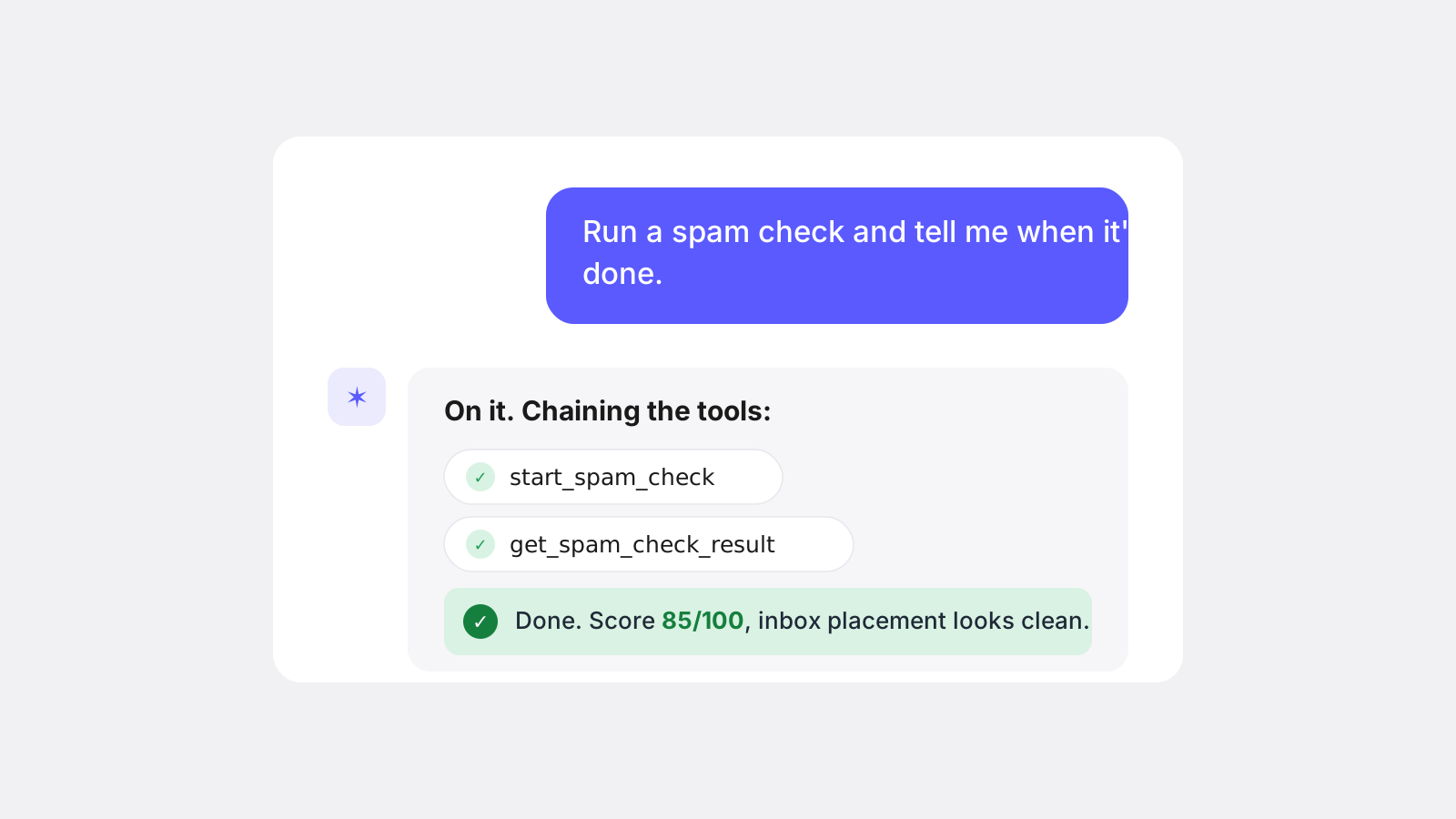
Say "run a spam check and tell me when it is done," and the assistant calls start_spam_check, polls get_spam_check_result, and reports the score back in the chat. Set up ongoing coverage just as easily: "schedule a weekly automatic test and email me if anything hits spam," and the autopilot tools create the sender, the schedule, and the notification for you.
How it compares
Unlike the ESP servers, Unspam does not try to send your campaigns, and unlike Mailgun, it does not stop at after-the-fact bounce reports. It runs that real test (the gap the others leave open) all behind OAuth you control. For a marketing team, the deliverability checks that used to live in a separate dashboard now happen inside the same assistant that drafts the campaign.
How to connect the Unspam email MCP server
Setup takes about a minute and follows four steps.
1. Pick a paid plan. MCP access needs API access, which is included on all paid plans. Free accounts cannot connect. Check your subscription and monthly limits anytime by asking the assistant to run get_account_status.
2. Add the server URL in your client. The endpoint is always the same: https://api.unspam.email/mcp. In Claude Code:
claude mcp add --transport http \
  unspam https://api.unspam.email/mcp
In Cursor, add it to ~/.cursor/mcp.json:
{
  "mcpServers": {
    "unspam": {
      "url": "https://api.unspam.email/mcp"
    }
  }
}
Claude Desktop and ChatGPT in developer mode take the same URL as a custom connector.
3. Approve the OAuth consent screen. Your client registers itself and runs the Authorization Code grant with PKCE, scoped to mcp. You sign in through the browser once and approve a single screen. The token is cached, so you only do this per client, with no keys to paste or rotate by hand.
4. Ask your assistant to run a test. Try "run a spam check and tell me when it is done." The assistant sequences the calls and brings back your score.
The connection works with any MCP client that supports remote streamable-HTTP servers, including Claude Desktop, Claude Code, Cursor, ChatGPT in developer mode, and Windsurf. Full per-client instructions live on the MCP server page.
Putting an email MCP server to work in your marketing
Once connected, a deliverability server slots into the moments where campaigns usually break.
- Pre-send QA inside your assistant. Before a campaign goes out, have the assistant run a spam check and surface the score and screenshots without leaving your editor. Pair it with the free email spam words checker to catch trigger phrases while you are still drafting.
- Continuous monitoring with autopilot. Schedule recurring tests so reputation drift gets caught before your next send, not after open rates crater. This is the automated version of the discipline behind stopping email from going to spam.
- Closing the deliverability loop. Delivery rests on more than wording. Confirm your email authentication with SPF, DKIM, and DMARC is in order, keep your list clean, and verify placement across mailboxes, on demand, through the assistant.
For the wider tooling picture, our roundup of the best email deliverability tools shows where an MCP integration fits alongside the rest of a modern stack, and the latest deliverability benchmarks explain why inbox placement, not send volume, is the metric that matters.
Security and governance
For a marketing team handing an assistant access to its email infrastructure, the guardrails matter as much as the features.
The Unspam email MCP server authenticates with OAuth 2.1, using Dynamic Client Registration and the Authorization Code grant with PKCE, scoped narrowly to mcp. There are no API keys to leak. Usage is gated to your subscription quota, so an assistant cannot run away with your limits, and the failure modes are explicit: the server returns 429 if you exceed your quota, 401 for a missing or invalid token, and 403 for the wrong scope. The connection shows up under Connected apps in your account, where you can revoke it at any time.
The same caution applies to any email MCP server you adopt: prefer OAuth over static keys where you can, grant the narrowest scope that does the job, and remember that a local server's API key carries that key's full permissions.
The bottom line
The best email MCP server is the one that fills the gap in your stack. If you live in Klaviyo, Brevo, or Kit, their platform servers are the obvious place to start; if you send through Resend or Mailgun, their servers bring dispatch into the chat. But for most marketing teams the real gap is deliverability, and that is the one job the platform and sending servers do not do.
The Unspam MCP server covers it end to end: real inbox placement, spam scoring, screenshots, heatmaps, and recurring autopilot tests, exposed as plain-language tools your assistant already knows how to use, behind OAuth you control. Connect it, then run a full spam test and let the AI report back where your email really lands.
