

If you manage email marketing for any business, you have probably encountered two terms that sound interchangeable but mean very different things: email spam test and email deliverability audit.
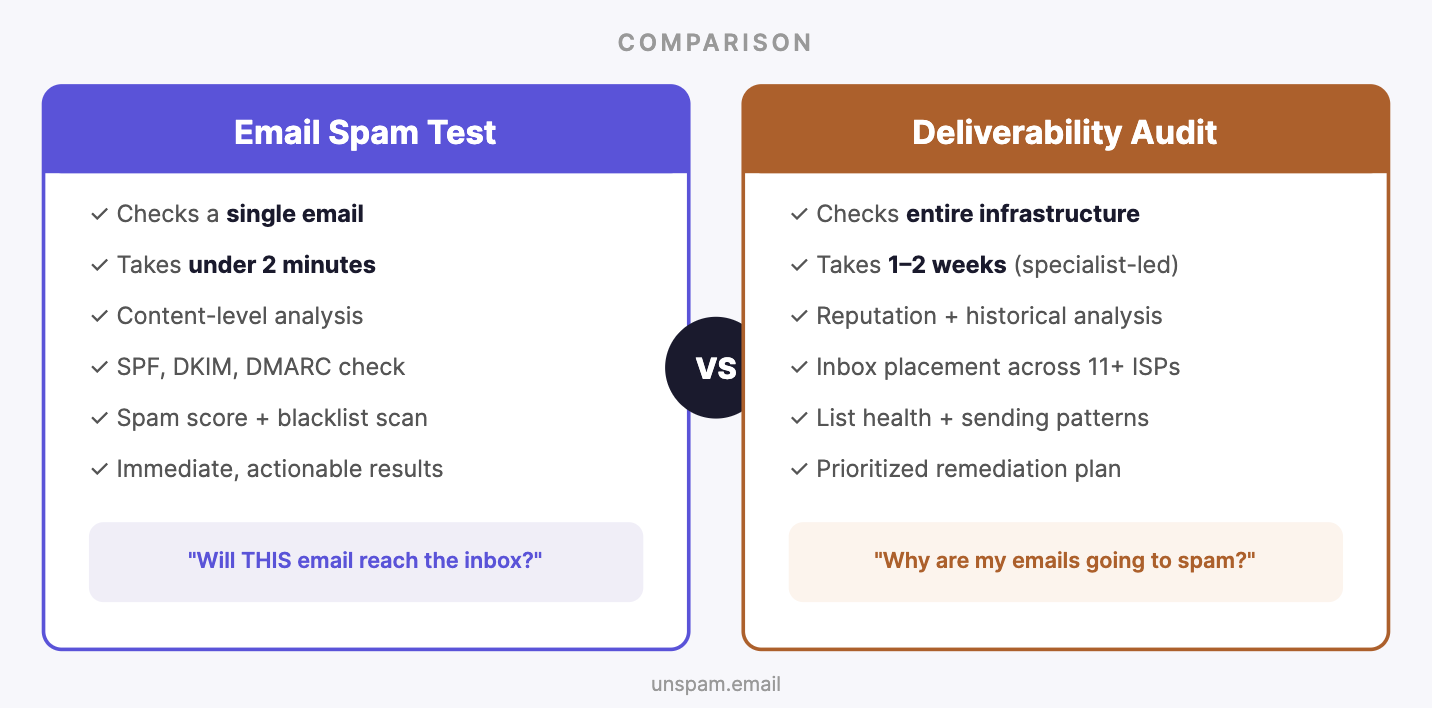
Confusing the two is one of the most common mistakes in email marketing, and it can be expensive. A spam test checks a single email at a single moment. A deliverability audit examines your entire sending infrastructure, reputation, and historical performance over time.
Understanding when to use each one can mean the difference between recovering thousands of dollars in monthly email revenue or wasting weeks troubleshooting the wrong problem.
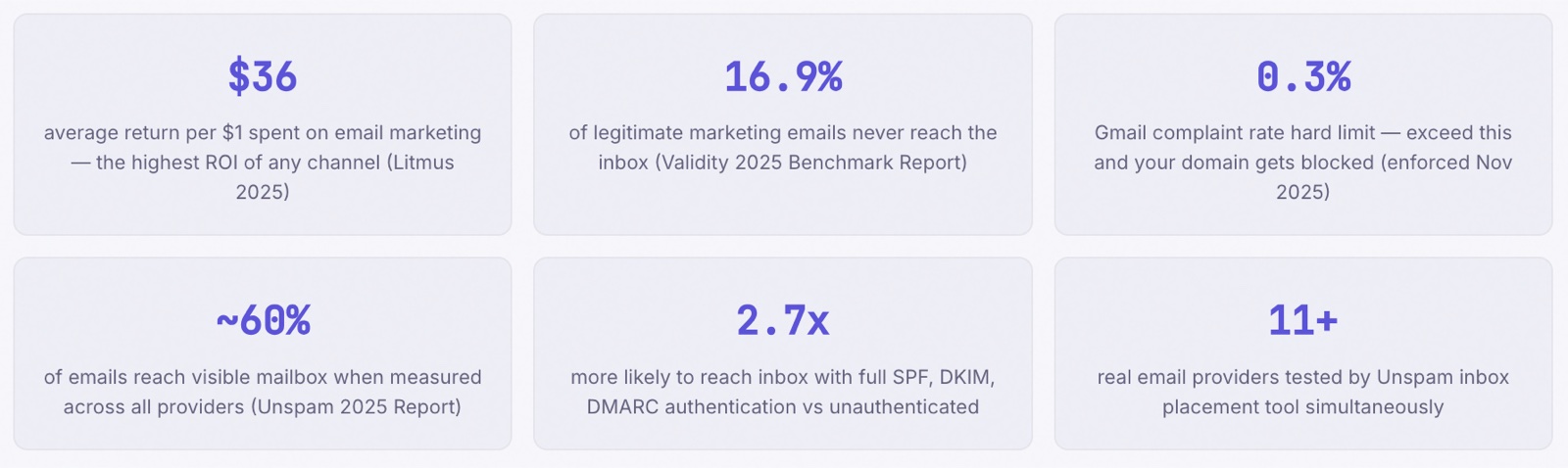
According to Validity’s 2025 Benchmark Report, roughly 1 in 6 legitimate marketing emails never reach the inbox. Unspam’s own 2025 Deliverability Report, based on millions of email tests, found that only about 60% of emails reach a visible mailbox location, even when they are technically “delivered.” The gap between delivery and inbox placement is exactly where businesses lose revenue without realizing it.
In this article, we break down exactly what each tool does, when you need which, how they complement each other, and how to build a deliverability workflow that protects your email revenue.
What is an email spam test?
An email spam test analyzes a single email message against a set of technical and content-based criteria. Think of it as a health checkup for one specific email, not your entire sending program.
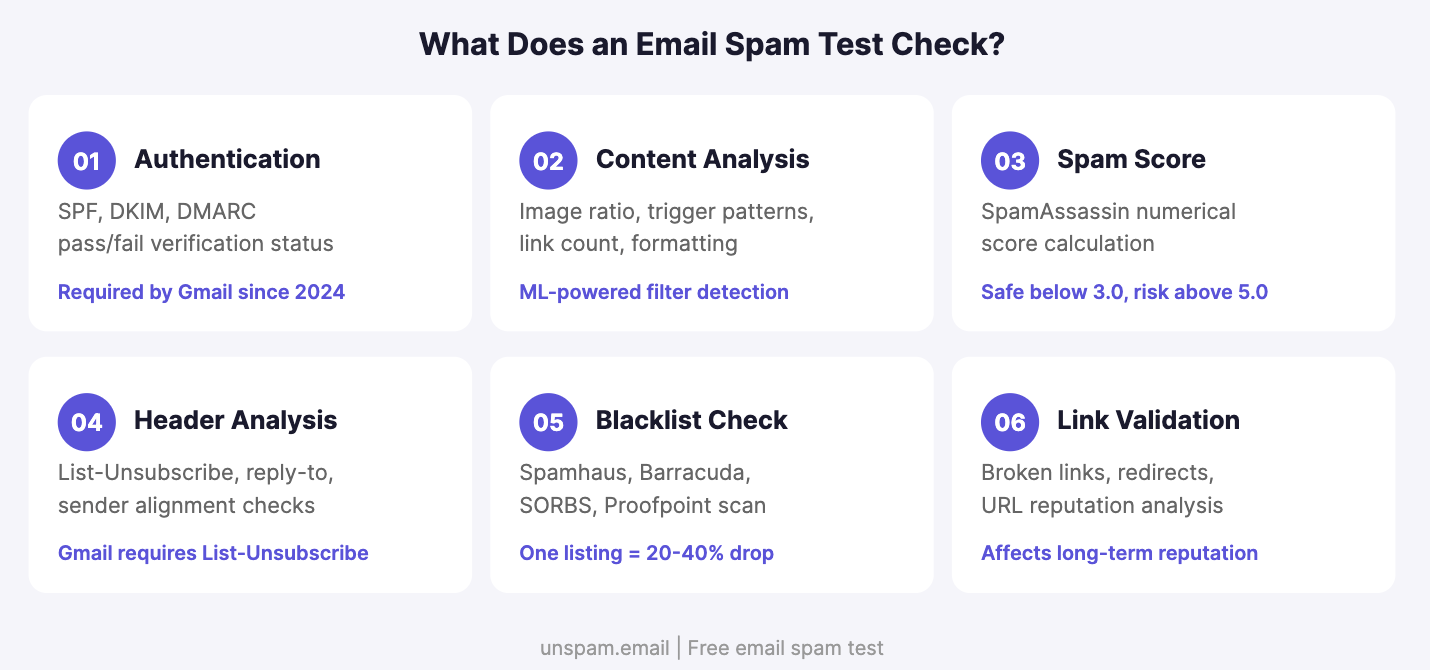
When you run a spam test through a tool like Unspam.email, the tool evaluates several factors simultaneously:
- Authentication records (SPF, DKIM, DMARC): Does the email pass all three authentication protocols? Since Google and Yahoo introduced mandatory sender requirements in February 2024 (with Gmail ramping up full enforcement in November 2025), all three are required for bulk senders sending 5,000+ messages per day. Microsoft followed with its own mandate effective May 2025 for Outlook.com, Hotmail.com, and Live.com. Emails failing any one of these face a dramatically higher chance of being filtered or rejected outright.
- Content analysis: Does the subject line or body contain patterns that trigger spam filters? This includes image-to-text ratio (emails with over 60% images are flagged more frequently), excessive links, URL shorteners, and specific phrases that correlate with spam. Modern filters powered by machine learning analyze patterns beyond simple keyword matching, so “avoiding spam words” alone no longer guarantees inbox placement.
- Spam score calculation: Most spam tests produce a numerical score based on the SpamAssassin framework. A score below 3.0 is generally considered safe. Above 5.0, most filters will quarantine the message. The score aggregates dozens of individual checks into a single pass/fail signal.
- Header analysis: Are email headers properly configured? Is the List-Unsubscribe header present (now required by Gmail for bulk senders)? Are reply-to addresses set correctly? Is the envelope sender aligned with the header sender?
- Blacklist check: Is your sending IP or domain listed on any major DNS-based blacklists? There are hundreds of active blacklists, but the ones that have the most impact are Spamhaus, Barracuda, SORBS, and Proofpoint. A single listing on Spamhaus can cause inbox placement to drop by 20-40% across multiple ISPs. This is more common than most senders assume: our benchmark data shows 3% of the sending IPs we check turn up on an IP blacklist.
- Link and URL validation: Are all links in the email functional? Do they point to domains with clean reputations? Broken links, redirect chains, and URL shorteners all contribute to spam filtering. Research from Unspam’s 2025 report found that link issues correlate with long-term reputation decay.
A spam test takes under 2 minutes and gives you immediate, actionable feedback on a specific email. It answers one question: “Will THIS email likely reach the inbox?”
$36: The average return for every $1 spent on email marketing (Litmus 2025 State of Email). Email consistently delivers the highest ROI of any marketing channel. When your emails miss the inbox, you are leaving a significant portion of that return on the table.
What a spam test does NOT tell you
This is where many businesses make costly mistakes. A spam test can come back clean (perfect authentication, low spam score, no blacklistings) while your emails are still landing in spam for thousands of recipients. That is because a spam test cannot evaluate:
- Your sender reputation: ISPs score your domain and IP based on months of sending history, engagement signals, and complaint data. A single email test has no access to this data.
- ISP-specific filtering: You might have 95% inbox placement on Gmail but only 60% on Microsoft Outlook. A spam test checks content quality, not provider-specific inbox routing.
- Engagement-based filtering: Gmail, in particular, now uses recipient engagement (opens, clicks, replies, deletes) to decide whether future emails from your domain reach the inbox. A content-level spam test cannot measure this.
- Sending pattern issues: Volume spikes, inconsistent sending frequency, and time-of-day patterns all affect deliverability. A spam test captures a snapshot, not a trend.
- List quality problems: Spam traps, role-based addresses, high inactive subscriber percentages, and excessive bounces erode your reputation over time. A single email test does not evaluate your list’s health.
This is exactly why a deliverability audit exists: to catch everything a spam test cannot see.
What is an email deliverability audit?
A deliverability audit is a comprehensive examination of your entire email sending infrastructure, reputation, and historical performance. If a spam test is a blood pressure check, a deliverability audit is a full medical examination with lab work, imaging, and specialist consultations.
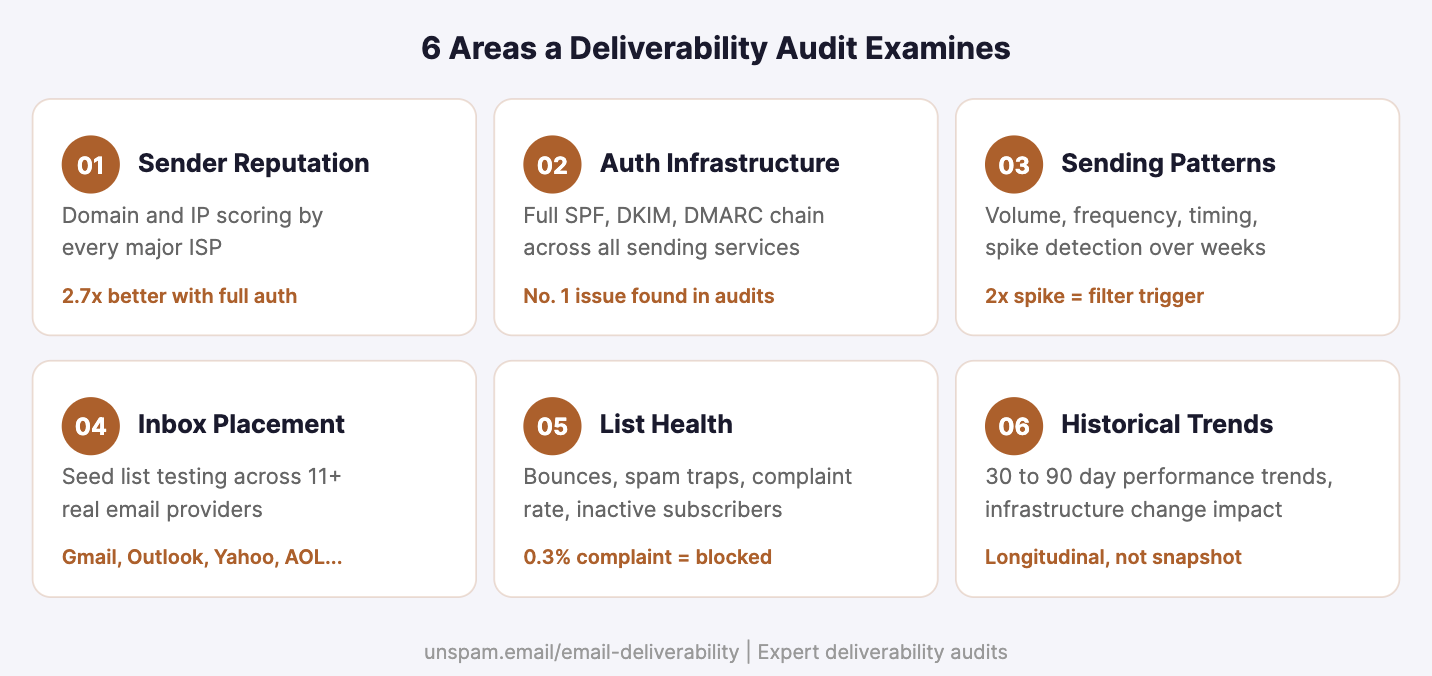
A thorough deliverability audit, like those conducted by the Unspam consulting team, examines six interconnected areas:
1. Sender reputation analysis
Your domain reputation and IP reputation are scored independently by every major ISP. Google Postmaster Tools categorizes domain reputation as High, Medium, Low, or Bad. Microsoft uses its own SNDS (Smart Network Data Services) scoring.
A “Medium” reputation on Google can mean 15-30% of your emails miss the inbox. B2B research shows that fully authenticated senders with mature domains are 2.7x more likely to reach inboxes than unauthenticated ones. New domains face a 30-percentage-point penalty compared to mature ones (55% vs 85% inbox placement).
2. Authentication infrastructure
Beyond checking if SPF/DKIM/DMARC pass for a single email, an audit verifies your entire authentication chain: alignment between envelope sender and header sender, DMARC policy enforcement level (none vs quarantine vs reject), and whether all sending sources are properly authorized.
Many businesses have 3-5 different services sending email on their behalf (marketing ESP, transactional service, CRM, support desk, sales outreach), and authentication gaps between them are the #1 issue found in audits. Across the domains we test, 90% publish a valid SPF record and 87% sign with a working DKIM key, yet DMARC remains the weak link: our benchmark data shows 58% of domains publish a DMARC policy, but 42% still have none at all.
3. Sending pattern analysis
ISPs track your sending patterns over weeks and months. A deliverability audit analyzes volume consistency, frequency patterns, time-of-day distribution, and any sudden spikes that may have triggered throttling.
Industry data shows that increasing sending volume by more than 2x in a single week frequently triggers ISP spam filters. Organizations sending 1M+ emails monthly have seen inbox placement decline by over 20 percentage points when patterns become erratic.
4. Inbox placement testing
Using seed list testing across real inboxes, an audit measures where your emails actually land, not just whether they were “delivered.” Unspam’s inbox placement tool tests across 11+ real email providers simultaneously (Gmail, Google Workspace, Outlook, Outlook Business, Yahoo, AOL, GMX, ProtonMail, Zoho, Zoho Business, Amazon WorkMail), giving you a provider-by-provider breakdown. You might be 100% inbox on Gmail but 40% spam on Outlook. A spam test alone would never reveal this.
5. List health assessment
An audit evaluates your list quality: hard and soft bounce rates, spam trap density, complaint rates, engagement distribution, and inactive subscriber percentage.
Google’s threshold is strict at 0.3% complaint rate: exceed this and your domain reputation drops, and you become ineligible for deliverability mitigation. Industry benchmarks suggest that lists with bounce rates above 2% are at high risk of degradation. A single spam trap hit can take 6-12 months to fully recover from.
6. Historical trend analysis
Rather than a snapshot, an audit examines trends over 30-90 days: is your reputation improving or declining? Are open rates trending down across specific ISPs? Has a recent infrastructure change (ESP migration, DNS update, new sending service) correlated with performance drops? This longitudinal view is what separates an audit from any point-in-time check.
When performed by a deliverability specialist, a full audit typically takes 1-2 weeks and produces a detailed report with prioritized recommendations. The investment typically pays for itself within the first month through recovered email revenue.
Spam test vs deliverability audit: when to use each one
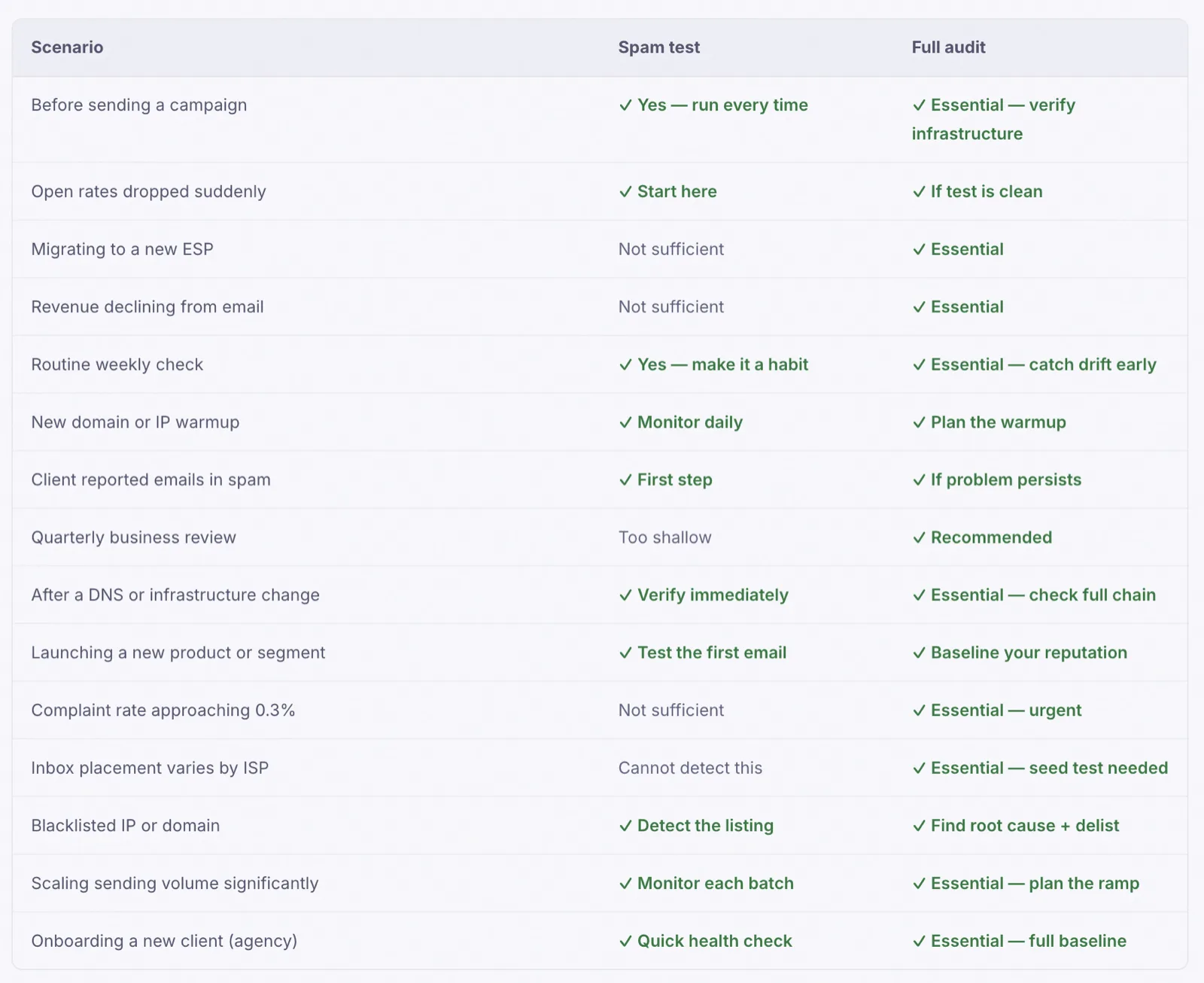
The decision framework is straightforward. Here is a scenario-by-scenario guide:
The real cost of using the wrong one
We see this pattern repeatedly at Unspam: a business runs a spam test, gets a clean score, and assumes their deliverability is fine. Meanwhile, their domain reputation has been declining for weeks, 20% of their emails are landing in spam on Outlook, and they are losing significant email revenue every month without realizing it.
The spam test passed because the email content was fine. The problem was infrastructure-level: sender reputation erosion, authentication gaps across multiple sending services, and a complaint rate that had crept above Google’s 0.3% hard threshold (recommended: below 0.1%) after a poorly targeted promotional blast.
Conversely, some businesses invest in expensive deliverability audits when all they needed was a quick spam test to catch a broken DKIM record after a DNS migration. A 2-minute test at Unspam.email, a free MailGenius alternative that checks authentication, content, and blacklists in a single pass, would have identified and resolved the issue in minutes.
The takeaway: use the right tool for the right problem. A spam test for routine checks and quick diagnostics. An audit when the problem is systemic, revenue is at stake, or you need a comprehensive baseline.
16.9% of legitimate marketing emails never reach the inbox (Validity 2025 Benchmark Report). That is roughly 1 in 6 emails lost. For a business sending 100,000 emails per month with an average email value of $0.50, that is $8,450 per month in invisible revenue leakage (over $100,000 per year).
How to combine both: the Unspam deliverability workflow
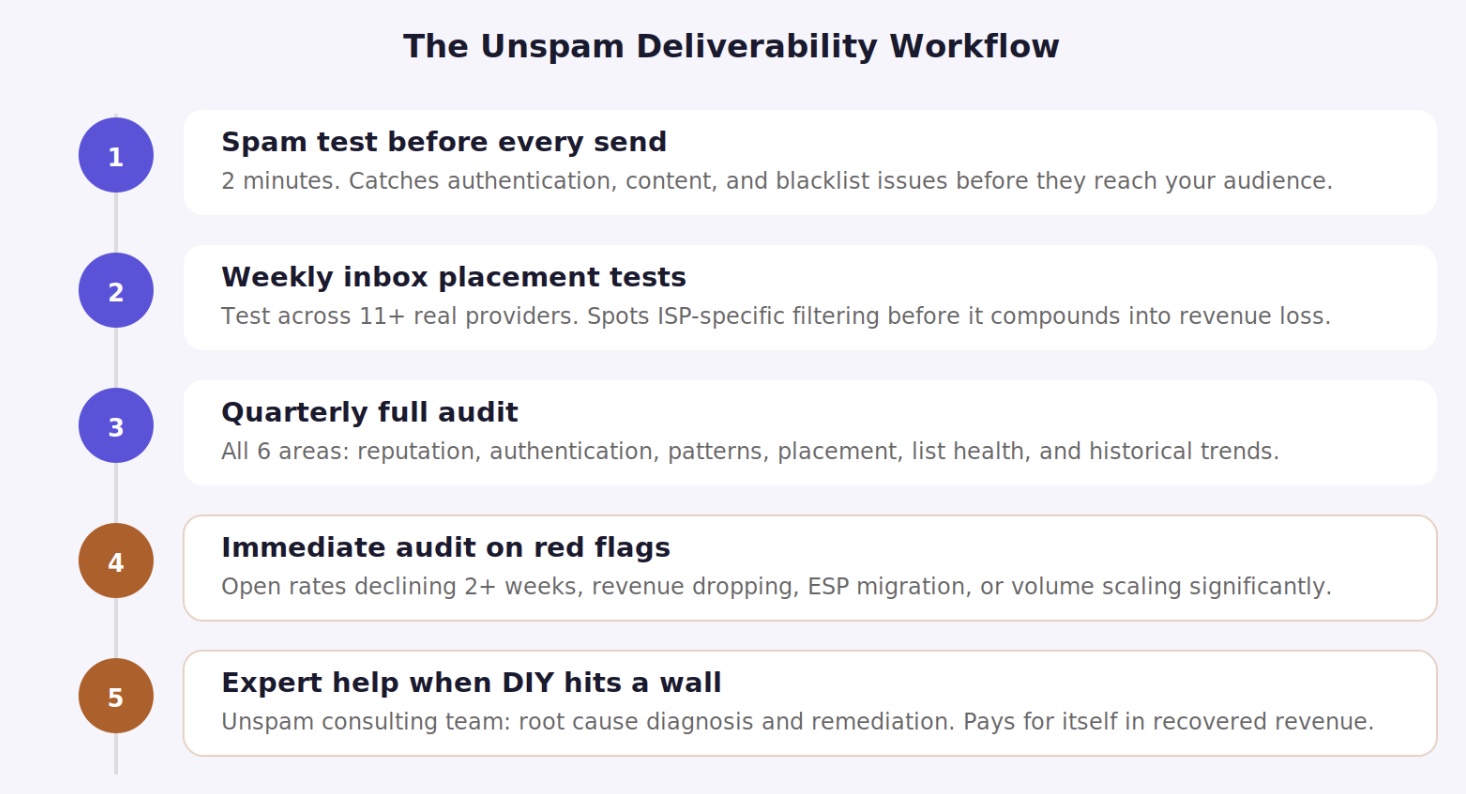
The most effective approach combines both tools in a structured, repeatable workflow:
- Run a spam test before every send. Make it a team habit. Before any campaign goes out, run the email through Unspam.email and check your spam score, authentication status, content flags, and blacklist status. This takes 2 minutes and catches the majority of one-off issues before they reach your audience.
- Run inbox placement tests weekly. Use Unspam’s inbox placement tool to verify where your emails actually land across Gmail, Outlook, Yahoo, and 8+ other real providers. This catches ISP-specific issues that a content-only spam test cannot detect. A weekly cadence is enough to spot trends before they compound.
- Schedule a full deliverability audit quarterly. Even if everything seems fine, a quarterly audit catches slow reputation drift, authentication changes from IT updates, and gradual list quality degradation. The audit should cover all six areas: reputation, authentication, sending patterns, inbox placement, list health, and historical trends.
- Run an immediate audit when red flags appear. Do not wait for the quarterly cycle if you notice: open rates declining over 2+ weeks, email revenue dropping without clear explanation, a recent ESP migration or major infrastructure change, or significant sending volume increases.
- Get expert help when DIY hits a wall. If your spam test is clean but inbox placement is poor, or if you have identified problems but lack the technical expertise to implement fixes, the Unspam consulting team can diagnose root causes and execute the remediation plan. The audit investment typically pays for itself within the first month through recovered revenue.
Key email deliverability statistics for 2026
Bottom line
A spam test and a deliverability audit serve different purposes and are not interchangeable. A spam test is your daily safety check: fast, focused, and essential before every send. A deliverability audit is your comprehensive diagnostic: deep, thorough, and essential when revenue is at stake or when something is systematically wrong.
The businesses that maintain the highest inbox placement rates use both: spam tests as a routine habit, and full audits as a strategic tool. Start with a free spam test at Unspam.email. If it reveals deeper problems, or if your email revenue is declining despite clean spam scores, it is time for a full deliverability audit with the Unspam consulting team.
