

Here’s a number that should bother you: 33% of emails land in spam.
Not 5%. Not 10%. A full third. That’s from our own data, aggregated from thousands of daily deliverability tests across every major provider and industry. It’s happening right now, in 2026, at a time when sender authentication is at an all-time high.
To put that in context: roughly 392.5 billion emails are sent and received every day worldwide in 2026, according to the Radicati Group’s Email Statistics Report 2024 to 2028, published December 2024. Nearly 48% of that volume is spam. That’s about 188 billion junk emails per day. The inbox has never been more crowded, and the filters have never been stricter.
We run the Unspam.email Deliverability Benchmark, which updates every 24 hours with real inbox placement data, authentication adoption rates, SpamAssassin scores, and content quality checks from millions of tests worldwide. Most deliverability reports are annual snapshots. Ours is a living dataset. The figures in this article use the fixed window of the Unspam 2026 Email Deliverability Benchmark Report: January to September 2026, compared with the full 2025 calendar year.
This article breaks down what we’re seeing in 2026. Some of the numbers are encouraging. Others are genuinely alarming. All of them are real.
The Big Picture: 88/100 Health Score, 63% Inbox Rate
The global Unspam deliverability health score sits at 88 out of 100, up from 83 in 2025. That sounds great. Excellent, technically.
But the inbox placement rate tells a different story. Only 63% of tested emails reach the actual inbox. Another 33% go straight to spam. About 3% get sorted into tabs (Promotions, Updates), and 1% go missing or get blocked.
Placement still improved sharply on 2025, when the same split read 49% primary inbox, 11% tabs, 36% spam and 4% missing or blocked.
Across all our checks, 89% come back clean, 9% trigger warnings, and 2% flag as critical failures, down from 7% in 2025. That 2% sounds small until you realize each email goes through 16+ discrete checks. One bad result can tip you into spam.
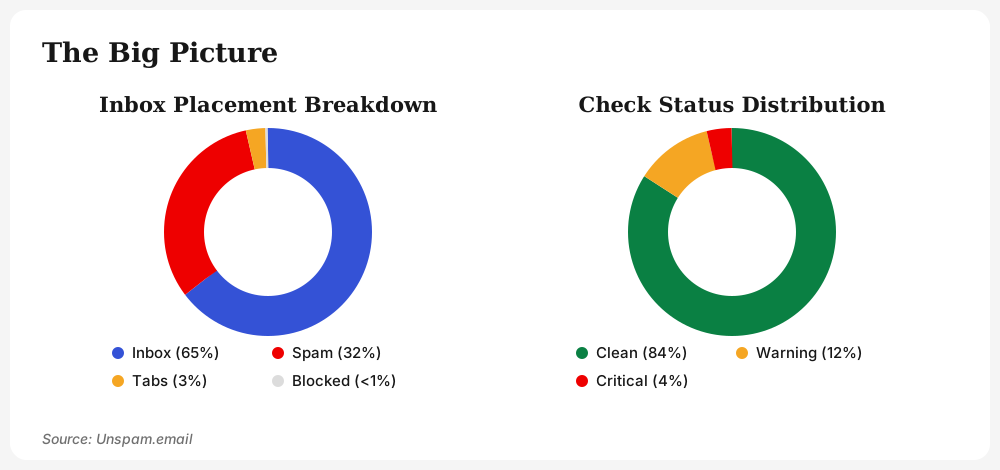
How can you have an “Excellent” Unspam deliverability health score and still lose a third of your emails to spam? Because the health score measures your setup (authentication, infrastructure, reputation) while inbox placement depends on a much larger set of variables: content quality, engagement history, and ISP-specific algorithms that change constantly. You can do everything right on the technical side and still get filtered.
For comparison, Validity’s 2025 benchmark report found that global inbox placement declined throughout 2024. EmailToolTester’s independent testing, last updated March 2026, puts the industry-wide average at 83.1% across the 15 ESPs it tests.
The Unspam Benchmark inbox rate is lower (63%) because we test across a broader range of senders, including cold outreach and transactional emails, not just established marketing programs. The discrepancy itself tells a story: your deliverability experience depends heavily on what kind of email you’re sending and how long you’ve been sending it.
The Unspam Deliverability Health Score
The Unspam deliverability health score is a 0 to 100 rating of a sender’s setup, weighting inbox placement at 60%, authentication at 25%, reputation at 10%, and technical compliance at 5%. Scores 85 to 100 = Excellent. 70 to 84 = Good. Below 70 = Needs Attention.
Where Your Emails Actually Land (by Provider)
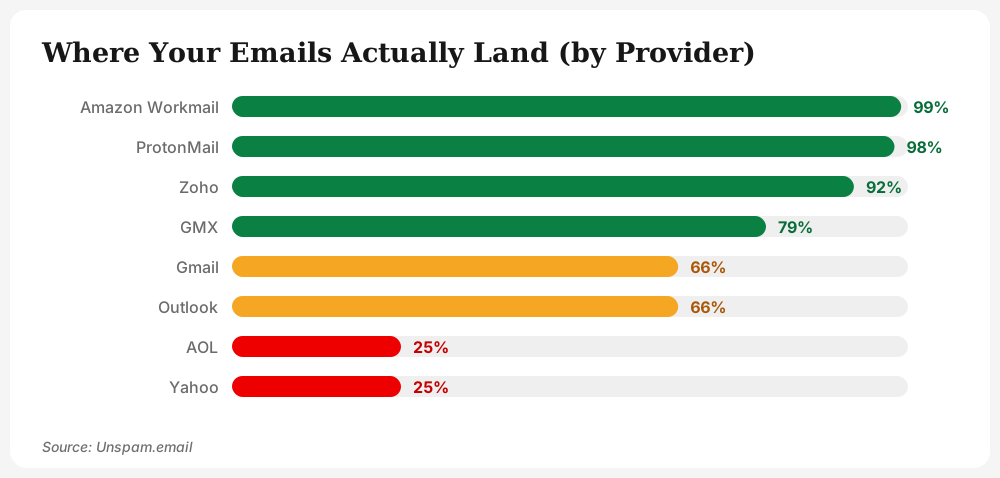
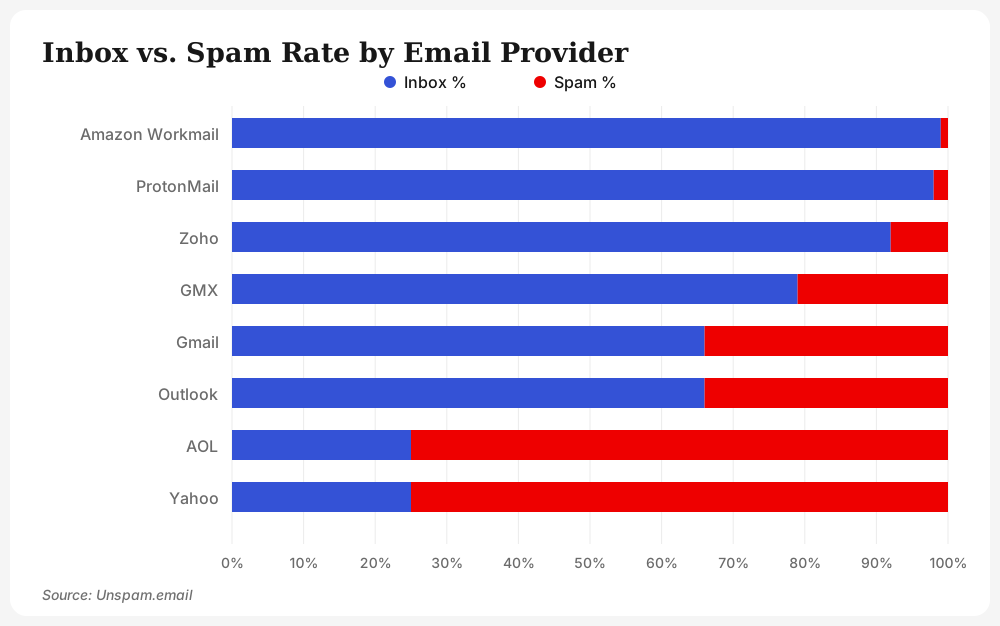
Inbox placement ranges from 99% at Amazon WorkMail to 22% at Yahoo, a 77-point spread. The inbox experience your subscribers have depends enormously on which provider they use.
| Provider | Inbox Rate | Spam Rate | The Reality |
|---|---|---|---|
| Amazon WorkMail | 99% | 1% | Near-perfect. Almost every email lands. |
| ProtonMail | 98% | 2% | Near-perfect. |
| Zoho | 93% | 7% | Strong performance. |
| GMX | 77% | 23% | Good. Above global average. |
| Outlook | 66% | 34% | Up sharply on 2025. Now four points ahead of Gmail. |
| Gmail | 62% | 38% | 38% hits spam. Not great. |
| AOL | 22% | 78% | Most emails miss the inbox. |
| Yahoo | 22% | 79% | Tied with AOL for the lowest of any provider we test. |
Read that again. Yahoo and AOL are the worst by a distance, letting only about a fifth of tested emails reach the inbox: 79% of emails to Yahoo and 78% of emails to AOL go to spam. Outlook moved the other way and now sits four points ahead of Gmail. Even Gmail, the provider most senders optimize for, spams 38% of emails.
Google reported 3 billion Gmail users in January 2026, and Gmail accounted for 24.11% of tracked opens in Litmus’s May 2026 email client data. That means the 38% spam rate at Gmail alone affects a staggering number of emails. And Gmail isn’t even the hardest provider to reach. Microsoft’s Outlook, which Validity’s 2025 Email Deliverability Benchmark Report places at 75.6% inbox, drops to 66% in our broader testing.
The spread from top to bottom is 77 percentage points. If a big chunk of your audience uses Outlook or Yahoo, you have a specific, provider-level problem that won’t show up in your overall metrics unless you segment by ISP.
Monthly Rates Moved Far More Than the Averages
The January to August averages hide how far individual providers moved inside 2026. On the eight-provider monthly panel, the average barely changed between December 2025 and August 2026, while six of the eight providers moved by more than ten points:
| Provider | August 2026 | December 2025 | Change |
|---|---|---|---|
| Amazon WorkMail | 98.6% | 100% | -1.4 |
| ProtonMail | 97.6% | 28.6% | +69.0 |
| Zoho | 93.9% | 98.3% | -4.4 |
| GMX | 73.0% | 85.7% | -12.7 |
| Outlook | 66.8% | 41.6% | +25.2 |
| Gmail | 51.7% | 63.5% | -11.8 |
| Yahoo | 15.3% | 45.4% | -30.1 |
| AOL | 14.7% | 48.4% | -33.7 |
| Panel average | 64.0% | 63.9% | +0.1 |
Gmail peaked at 77.3% in February 2026 and slid to 51.7% by August, the same early peak and long decline it showed in 2025. Yahoo and AOL fell together, and Outlook climbed from the bottom of the 2025 table. The Unspam 2026 Email Deliverability Benchmark Report charts every month for all eight providers.
Gmail Tab Distribution
Among tested emails that Gmail places in the inbox, the vast majority land in Primary (88%), up from 82% in 2025. Updates captures 8%, Forums 3%, and Promotions 1%. The tab problem is mostly a myth at this point. The real battle is getting past the spam filter.
Email Authentication Statistics: Record Highs, Still Not Enough
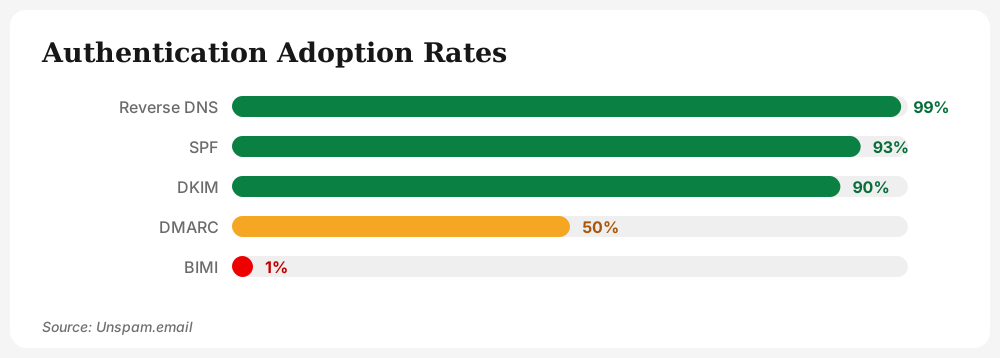
SPF hit 93% and DKIM 90% in 2026, and neither is enough on its own: the global inbox rate is still 63%. Reverse DNS is at 99%. These are real, meaningful improvements over 2025, when the same checks found SPF on 86% of senders and DKIM on 82%.
Now the part that matters more: DMARC went backwards, from 59% in 2025 to 48% in 2026.
52% of email-sending domains still have no DMARC policy, and that share grew over the past year. Google and Yahoo made DMARC a requirement for bulk senders in February 2024. Gmail tightened enforcement further in November 2025. If you’re still running without DMARC, you’re telling ISPs you haven’t caught up to a standard that’s now two years old. They notice.
For additional context: EasyDMARC’s 2025 adoption report found that global DMARC adoption among top domains surged 64% between 2023 and 2025, from 29.1% to 47.7%. Our 48% figure is higher because we measure actual deployment across tested senders, not just DNS presence among top domains. The gap between “has a DMARC record” and “enforces a DMARC policy” remains significant.
Mailgun’s 2025 State of Email Deliverability report found that 48% of email marketers cite avoiding the spam folder as their biggest challenge. Authentication alone doesn’t solve that problem, but not having it guarantees you’ll face it.
| Protocol | Adoption | What This Means |
|---|---|---|
| SPF | 93% | Strong and growing. The 7% without it face near-automatic filtering at Gmail and Yahoo. |
| DKIM | 90% | Up 8 points on 2025. Requires more technical effort than SPF (key management, DNS). |
| DMARC | 48% | The biggest gap, and the only one moving backwards. 52% of senders remain exposed and unprotected. |
| BIMI | 1% | Barely exists. Requires DMARC enforcement + VMC ($1,500+/year). |
| Reverse DNS | 99% | Basically universal. Missing it gets you rejected outright. |
SPF and DKIM are no longer differentiators. When 90%+ of senders have them, they’re just table stakes. The real question ISPs ask now is whether you have DMARC enforcement, whether your subscribers actually open your emails, and whether your content passes their increasingly aggressive filters.
The Check-by-Check Breakdown
List-Unsubscribe is the worst check on the board at 14%, and HTML best practices the second worst at 43%. Every email we test goes through 16+ discrete checks, sorted here from best to worst:
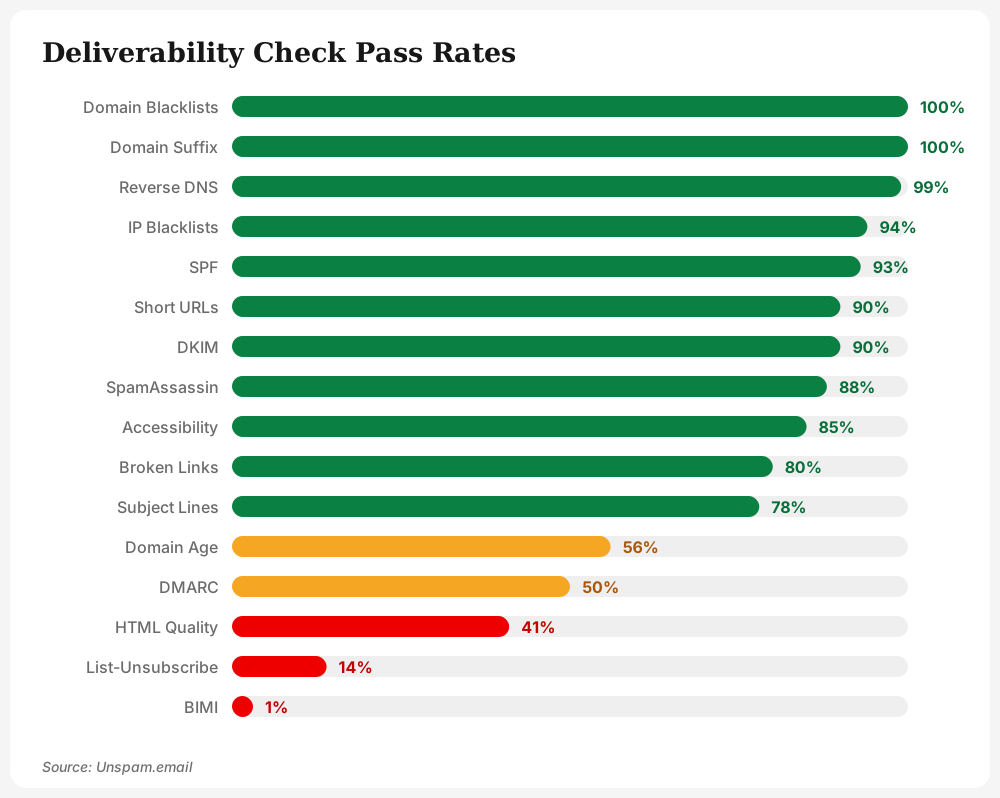
| Check | Pass Rate | What You Should Know |
|---|---|---|
| Domain Blacklists | 100% | Rounds to 100%, yet 0.3% of tested domains carry a listing, and a listing is a strong negative signal. |
| Domain Suffix Reputation | 100% | Your TLD matters. .com accounts for 55.06% of tested domains. |
| Reverse DNS | 99% | Missing this gets you rejected outright. |
| IP Blacklists | 94% | The 6% listed face devastating deliverability drops, and that share tripled on 2025. |
| SPF Records | 93% | Up 7 points on 2025. Good trajectory. |
| Short URL Avoidance | 90% | Down 10 points on 2025. Don’t use bit.ly or similar shorteners in emails. |
| DKIM Signatures | 90% | Up 8 points. Solid improvement. |
| SpamAssassin Content | 89% | 11% of emails have content that triggers spam patterns. |
| Accessibility | 85% | 15% fail, usually for invisible or low-contrast text. What readers can’t see, they can’t click. |
| Broken Links | 80% | 20% contain dead links. Each one hurts engagement and reputation. |
| Subject Line Quality | 79% | 21% of subjects trigger spam analysis flags, down from 60% in 2025. |
| Domain Age | 57% | Just under half of domains are too new for full ISP trust. |
| DMARC Policies | 48% | 52% of senders are unprotected, up from 41% in 2025. |
| HTML Best Practices | 43% | 57% fail basic HTML validation. This directly affects filtering. |
| List-Unsubscribe | 14% | 86% missing. The worst stat in this entire benchmark. |
| BIMI Records | 1% | Barely exists at scale. |
Three of those checks deserve a closer look because they’re both terrible and fixable.
List-Unsubscribe at 14%
86% of tested emails are missing a List-Unsubscribe header, the one-click unsubscribe mechanism that Gmail and Yahoo now require for bulk senders. This one frustrates me the most. Without it, people who want off your list have one option: the spam button. Every spam button click tanks your reputation.
Mailgun’s research found that 48% of email marketers say avoiding the spam folder is their biggest challenge. And yet 86% of them aren’t implementing the single easiest fix. The irony is hard to overstate. The fix takes about 10 minutes in most ESPs.
HTML Quality at 43%
57% of tested emails fail basic HTML validation. Malformed tags. Missing doctypes. Broken inline CSS. That is a real improvement on 2025, when 77% failed, and most email still arrives with markup that risks broken rendering and failed parsing.
This isn’t just about rendering. Poorly structured HTML triggers parsing-based spam filters. Your beautiful campaign template might be getting you flagged.
Subject Lines at 79%
21% of subject lines trip at least minor spam flags, down from 60% in 2025. The usual offenders: aggressive urgency language (“Act Now,” “100% Free,” “Urgent”), ALL CAPS (2% of emails), emoji overuse (3%), and lines over 60 characters (7%). Those three formatting patterns together cover only 12% of subject lines, so most flags come from wording rather than formatting.
SpamAssassin Score Distribution
88% of tested emails fall in the two bands below 3.0, where content-level filters leave you alone. Here is the full 2026 distribution:
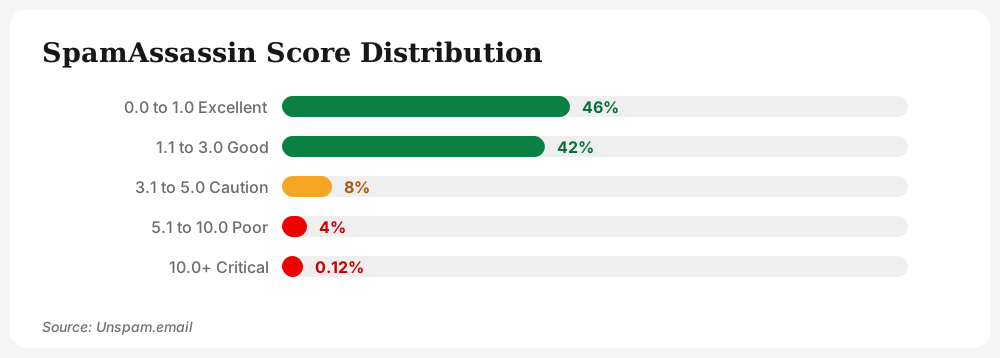
| Score | Rating | % of Emails | What Happens |
|---|---|---|---|
| 0.0 to 1.0 | Excellent | 47% | Inbox. Clean, no flags. |
| 1.1 to 3.0 | Good | 41% | Inbox. Minor issues, nothing triggering. |
| 3.1 to 5.0 | Caution | 8% | Filtering starts here. |
| 5.1 to 10.0 | Poor | 4% | Probably spam folder. |
| 10.0+ | Critical | 0.13% | Blocked. |
The 12% scoring above 3.0 are in trouble. If you’re not testing your SpamAssassin score before sending, you’re flying blind. For what each score band means and how to lower a high score, read the full SpamAssassin score guide.
Email Deliverability by Industry
Education leads inbox placement at 75% and Retail & E-commerce trails at 63%, despite health scores within 0.6 points of each other. All eight industries placed better than in 2025.
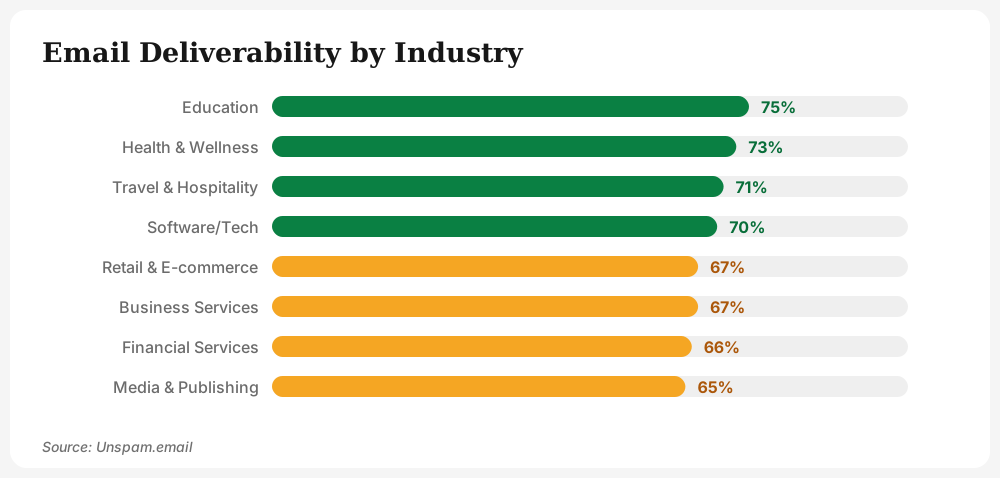
| Industry | Inbox Rate | Health Score | What Stands Out |
|---|---|---|---|
| Education | 75% | 89.5 | Best inbox placement; Above Average setup |
| Health & Wellness | 71% | 89.2 | Top Quartile setup |
| Travel & Hospitality | 70% | 87.2 | Strong placement despite the lowest health score |
| Software & Tech | 69% | 89.6 | Second-highest health score, fourth on placement |
| Business Services | 67% | 89.9 | Highest health score, mid-table placement |
| Financial Services | 65% | 88.0 | Second-lowest health score, sixth on placement |
| Media & Publishing | 64% | 88.4 | Just above the global average, second from the bottom |
| Retail & E-commerce | 63% | 88.9 | Lowest placement, despite a mid-table setup |
What catches my eye is how little the health scores explain. Across all eight industries the compliance scores cluster in a tight band, from 87.2 (Travel & Hospitality) to 89.9 (Business Services). Barely 2.7 points separate the best-set-up industry from the worst. Inbox placement, by contrast, ranges from 63% to 75%, a spread more than four times wider. The technical setup is essentially solved everywhere; what reaches the inbox is not.
And the two no longer track each other. Education now leads inbox placement at 75%, and Travel & Hospitality still places well at 70% despite having the lowest health score of any sector (87.2). Meanwhile Retail & E-commerce sits at the bottom (63%) even though its compliance score (88.9) is within a rounding error of everyone else’s. Same authentication, same infrastructure hygiene, twelve-point swing in placement. The old assumption that a stronger technical setup buys you the inbox simply doesn’t hold in this data.
If health score doesn’t predict placement, what does? Engagement and content intent. Education and Health & Wellness (71%) tend to send wanted, transactional, low-promotional mail that subscribers actually open. Retail and Financial lean heavily on promotional sends and recurring offers, which ISPs scrutinize harder regardless of how clean the DNS records are.
For context on the broader email marketing picture: in Litmus’s 2025 State of Email survey, 35% of marketing leaders reported $10 to $36 back for every $1 spent on email, 30% reported $36 to $50, and 5% reported more than $50. Those returns only materialize when emails actually reach the inbox. At a 63% global inbox rate, just over a third of that potential ROI is being left on the table.
Regulatory Compliance Rose Fastest, and CAN-SPAM Still Trails
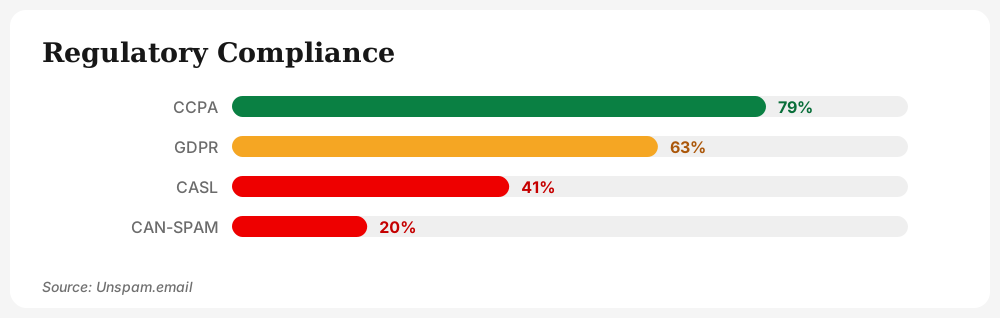
Compliance improved faster than any technical check, and CAN-SPAM compliance is still only 35%, about one sender in three, for the primary anti-spam regulation in a country that sends 9.8 billion emails per day (Statista, August 2025). In 2025 it was 3%. CCPA is the best of the bunch at 85%, up from 72%. GDPR sits at 76%, up from 49%. CASL rose furthest, from 19% to 62%. Two senders in three still miss at least one CAN-SPAM requirement, and that is legal risk hiding in the footer.
BIMI: The Brand Feature Almost Nobody Uses
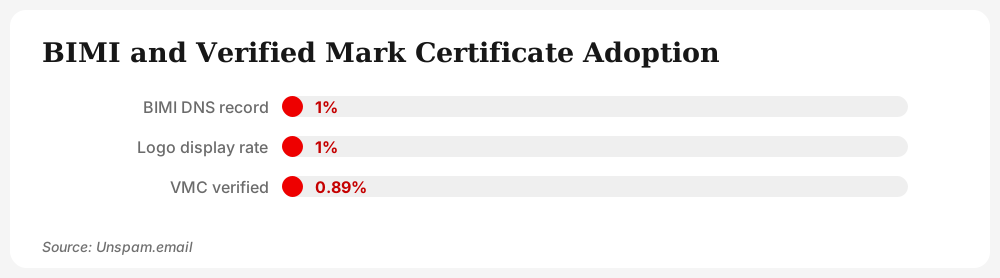
1% of tested domains have a BIMI DNS record, only 0.94% have a Verified Mark Certificate (up from 0.52% in 2025), and the logo display rate is 1%. That is why you almost never see a brand logo in your inbox.
BIMI lets you show your verified brand logo next to your emails. Gmail supports it, and so does Apple Mail. The evidence for what it buys you is thinner than the usual claims suggest: a 2021 Red Sift and Entrust survey of 1,026 UK and US adults found that displaying a logo lifted open rates 21% and brand recall 18%, and raised stated confidence in an email’s legitimacy by 90%. None of that isolates a Verified Mark Certificate from any other mark certificate.
BIMI Adoption by Industry
Education ties with Software and Technology at the top of BIMI adoption, both at 11%, and every other sector sits at 10% or below.
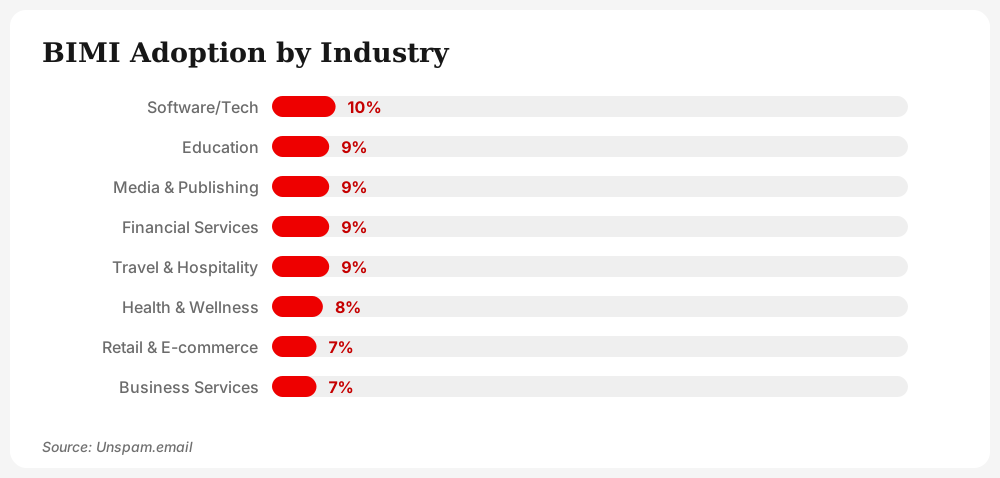
| Industry | Adoption | Context |
|---|---|---|
| Education | 11% | Joint highest, despite tight budgets for VMC investment. |
| Software & Technology | 11% | Joint highest. Technical teams drive faster adoption. |
| Financial Services | 10% | Anti-phishing and trust are critical use cases. |
| Health & Wellness | 9% | Credibility matters for patient communication. |
| Media & Publishing | 9% | Brand differentiation is a competitive priority. |
| Travel & Hospitality | 8% | Strong branding influences booking decisions. |
| Retail & E-commerce | 7% | Visual branding directly impacts purchase decisions. |
| Business Services | 6% | B2B focus means slower adoption curve. |
The barriers are real. You need DMARC enforcement first (which 52% of senders don’t have), plus a VMC costing $1,500+ annually. But for consumer brands where inbox trust directly drives revenue, the math works. Early adopters are seeing measurable results.
Inbox Placement & Deliverability (Unspam 2026 Benchmark)
- 63% global inbox placement rate. 33% of emails land in spam. 3% sorted into tabs.
- 88/100 global deliverability health score (rated Excellent).
- 89% of all deliverability checks pass (OK status), 9% warn, 2% fail critically.
- Yahoo and AOL share the lowest inbox rate at 22%. 79% of emails to Yahoo and 78% to AOL land in spam.
- Outlook sends 34% of tested emails to spam, so its inbox rate is 66%.
- Gmail delivers 62% to the inbox, with 88% of inbox-placed Gmail emails landing in the Primary tab.
- Amazon WorkMail (99%) and ProtonMail (98%) deliver the highest inbox rates.
Authentication Adoption (Unspam 2026 Benchmark)
- 93% SPF adoption.
- 90% DKIM adoption.
- 48% DMARC adoption. 52% of senders remain unprotected.
- 1% BIMI adoption. Only 0.94% have VMC-verified logos.
- 99% Reverse DNS adoption.
Content Quality (Unspam 2026 Benchmark)
- 14% List-Unsubscribe compliance. 86% of emails miss this required header.
- 43% HTML best practices pass rate. 57% of emails fail basic HTML validation.
- 79% subject line quality pass rate. 21% trigger spam analysis flags.
- 80% broken link clean rate. 20% of emails contain at least one dead link.
- 85% accessibility compliance. 15% of emails fail at least one accessibility check.
- 57% domain age pass rate. Just under half of the tested domains are too new for full ISP trust.
All Unspam Benchmark statistics are from the Unspam.email Deliverability Benchmark, January to September 2026, the window of the Unspam 2026 Email Deliverability Benchmark Report (data from thousands of tests across 195+ countries). Please credit Unspam.email when referencing this data.
What You Should Actually Do About All This
Add a List-Unsubscribe header first: 86% of emails lack one and it takes ten minutes. The rest, in order of impact relative to effort:
- Add List-Unsubscribe headers. 86% of emails are missing them. It takes minutes to set up. Gmail and Yahoo require it. This single change reduces spam complaints faster than anything else.
- Set up DMARC with enforcement. Move to p=quarantine or p=reject. 52% of senders still don’t have DMARC, a share that grew this year. ISPs are penalizing you for it.
- Fix your HTML templates. 43% pass rate. Run them through a validator. Fix the broken tags and missing doctypes. Do it once.
- Clean up subject lines. 21% raise flags. Drop the urgency language. Lose the ALL CAPS. Keep it under 60 characters. Test before you ship.
- Check links before every send. 20% broken link rate. Automate this.
- Segment by provider. If your audience uses Outlook (66% inbox) or Yahoo (22% inbox), you need dedicated strategies per ISP.
- Test SpamAssassin scores. 12% of emails score above 3.0. If yours do, you’re losing placement.
- Consider BIMI if you’re a consumer brand. Gmail and Apple Mail both display it. The measured lifts are modest and five years old, so treat the cost as the deciding factor.
The Bigger Picture
Authentication is climbing and it’s still not enough. SPF and DKIM are at 90%+. Inbox placement is at 63%. That gap is about engagement signals. ISPs now layer behavioral data (opens, clicks, replies) on top of technical checks. Perfect authentication with poor engagement still gets you filtered.
The provider gap is enormous. 77 points between Amazon WorkMail (99% inbox) and Yahoo (22% inbox) across January to September 2026. Treating deliverability as a single number is increasingly pointless.
Content quality is moving unevenly. List-Unsubscribe at 14%. HTML at 43%. Subject quality at 79%. All fixable, most of them quickly. HTML and subject lines improved sharply on 2025, while List-Unsubscribe moved two points in a year, which suggests the cheapest fix is the one nobody owns.
Regulatory exposure is shrinking, not gone. CAN-SPAM at 35%. GDPR at 76%. Both rose sharply on 2025, and two senders in three still miss CAN-SPAM.
Methodology
This analysis uses data from the Unspam.email Deliverability Benchmark for January to September 2026, the window of the Unspam 2026 Email Deliverability Benchmark Report, with 2025 comparisons covering the full 2025 calendar year. We aggregate and anonymize results from thousands of daily tests across major ESPs, enterprise senders, and monitoring platforms in 195+ countries. The live benchmark keeps updating every 24 hours, so its current figures will move away from the ones quoted here.
The interactive dashboard lets you filter by time period, provider, and industry. For a personalized email deliverability audit, talk to our email deliverability consultants.
